Mostrando entradas con la etiqueta vocabulary. Mostrar todas las entradas

DESCRIBING FILMS AND TV SERIES. SPEAKING

DO YOU LIKE WATCHING MOVIES AND SERIES?

ARE YOU INTO READING BOOKS? Have you ever been hooked on a tv series or books?

So, this post is for you!!

FIRST OF ALL, LET'S FOCUS ON THE BASIC VOCABULARY:


DESCRIBING A FILM, BOOK OR SERIES. JUANA MORAL'S ENGLISH SITE.SPEAKING


MEMBERS OF THE FAMILY. VOCABULARY

 CAN YOU NAME THE MEMEBERS OF THE FAMILY IN ENGLISH? 
Watch the following video from WOODWARD ENGLISH and focus on pronunciation


Together with this, there are more members to bear in mind: 

BROADCAST YOUR NEWS PROGRAMME!! SPEAKING.

My students' next project is to broadcast a video with the news. They can choose several interesting topics, create their own HEADLINES and introduce whatever they find interesting.

The news. Speaking communicative project at Juana Moral's English Site


Have a look at this brilliant example from CHANNEL 2 KIDS NEWS (CLICK TWICE TO WATCH IT ON YOUTUBE):


Now, let us focus on some useful expressions, necessary for your news programme.Then, you can have a look at more videos and interesting links:

OUR ECOLOGICAL DREAM HOUSE. PBW/ ABP/ SPEAKING

How can you create a motivating project based work to teach the parts of the house while you include ecological elements? How can you make your students combine ICT, Biology, Arts and English in an interdisciplinary task? They have to collaborate and use the create their ECOLOGICAL DREAM HOUSES. COME AND SEE!!


to

HOUSES AND HOMES

Do you need more vocabulary to revise and pronounce the rooms in the house?

Can you tell more names of pieces of furniture? Can you tell some some house appliances?

The following video will increase your vocabulary power, sure!!


After all that learning, let us practice some more with the following matching activity. Enjoy yourselves!!
Click here:

ALPHABET GAME: VOCABULARY REVISION

The following ALPHABET GAME activity can help you to revise the vocabulary of the first units: body parts, numbers, family members, adjectives to describe people and so on. 

Games can be great to improve, learn and revise English!
Enjoy it

Remember to study also more posts in this blog, including, to be, have got, questions, parts of the body and descriptions.

Art and architecture. ABP. Speaking and writing

How do you describe a famous building in your language? Can you talk about any famous places and sites? Can you name the different art styles in English? 

SYDNEY'S OPERA HOUSE IS STUNNING!! JUANA MORAL'S ENGLISH SITE

The following presentation can help you to learn more about it. Here, we can see some ideas for a project based teaching (ABP, PBL) experience in which we can combine social sciences and English language learning to improve interdisciplinarity.


Hence, we should learn about the different art and architecture styles and then choose a famous building to describe it. We can prepare both writing and speaking activities using some structures which will be necessary to make our project alive.


Describing a city

Describing a city is really interesting both for writing and for oral presentations.

In order to do this, you should include the following information:

WHY NOT DESCRIBING NEW YORK? Writing. Juana Moral's English Site


WHAT'S THE WEATHER LIKE TODAY? ELT

What's the weather like? It's a typical question: ¿Qué tiempo hace hoy?


To answer to this question, we have to take into account the following ideas:

  • It: (subject of the answer). Always obligatory at the beginning of the sentence
  • We use the verb TO BE to talk about the weather: It's sunny 
  • Auque en español decimos: Hace frío , hace calor. ESe verbo en inglés es TO BE (iT'S HOT); Aunque en español es impersonal, en inglés el SUJETO ES SIEMPRE OBLIGATORIO.

THe following picture from easypacelearning will help you to improve your vocabulary: 


WRITING THE DATE: DAYS OF THE WEEK, MONTHS AND ORDINAL NUMBERS

POZOBLANCO, MONDAY 23RD NOVEMBER 2015
Writing the date can be difficult, and sometimes, pronouncing it is even more difficult. Anyway, we can make it easy for Primary Students and 1st Year of ESO students.  Let's follow some tips to help you, 

  • DAYS OF THE WEEK
  • Can you pronounce the days of the week? Really easy if you listen and repeat: 


    HAIRSTYLE VOCABULARY for ESO

    Can you describe your hairstyle?

    Use this picture to help you:

    What about the colour?
    • Blond: Rubio; FAir: claro
    • Dark: Oscuro
    • Brown, Black
    • Red: Rojo . A red-haired girl: una chica pelirroja. We can  write the colour+ add -ed to the part of the body and create a compound noun to describe people: a blue-eyed boy.
    • Dyed hair: pelo teñido (hair with some colour in it)
    • With highlights: pelo con mechas
    What are you like? Which are your favourite hairstyles? Would you like to have a makeover?


    PLACES IN TOWN in English. Vocabulary for 1º, 2º ESO

    WHAT CAN YOU DO IN YOUR CITY OR TOWN? Where can you go?

    Watch and listen!!


    In the following link, can also find a quizz on public places, which is good to revise. Pay attention, because some words are written in American English, can yo name them in British English?


    Can you relate any jobs to these places?
    I strongly recommend you to enter the following link from the BRITISH COUNCIL in which there are activities to check your knowledge.
    It is also a great idea to go to ESOL COURSES PAGE in which you can both learn more vocabulary and do activities.
    GO AHEAD.

    What do you do? JOBS IN ENGLISH


    • What's your job? What do you do? 
    These expressions are used to ask about jobs and employment. The word WORK is a verb which means TRABAJAR, and it's also used in expressions like: Hard work (trabajo duro). We say:
    •  "I work as a teacher, I work as a lawyer"


    The word CAREER is used to refer to employment, (carrera laboral in Spanish, "I have a long career as singer"). Carrera referring to studies is called: Degree (carrera universitaria).


    DAILY ROUTINES. What do you usually do? ELT PRESENT SIMPLE AND VOCABULARY


    Which things do you do everyday? Which are your favourite?
    As you know, to talk about our routines we use the SIMPLE PRESENT (remember, the base form plus "s" for third person singular. Auxiliary verb Do/does for negative and interrogative)
    In the following video, you can see some of them and also make a quizz at the end.


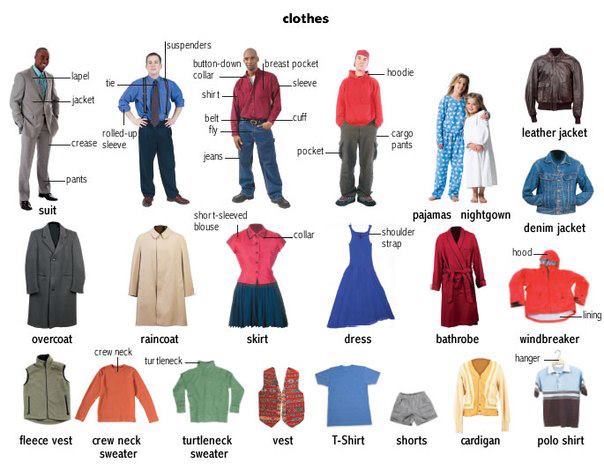
    WHAT ARE YOU WEARING? CLOTHES VOCABULARY

    Can you describe the clothes you are wearning at the moment?A good help can be the following worksheet in which there are pictures of some typical clothes:

    TIPS TO REMEMBER 

    • WEAR means llevar puesto (I'm wearing a tracksuit)
    • CARRY means llevar, transportar (I'm carrying a school bag)
    • PUT ON means ponerse. TAKE OFF means quitarse
    • GET DRESSED means vestirse. GET UNDRESSED means desvestirse
    • NAKED means WITH NO CLOTHES (desnudo). BAREFOOTED means WITH NO SHOES (descalzo)
    • TO BE DRESSED TO KILL means something like BEING REALLY GORGEOUS: de punta en blanco

    • When describing clothes, don't forget to write adjectives before nouns: A RED SKIRT, A SILK SHIRT (note that materials are also adjectives and don't need preposition in English:  una camisa de seda in Spanish: a silk shirt (CAMISA DE SEDA), or a wool sweatshirt (un jersey de lana)). That is, we never use the prepositon OF.


    We are what we eat: food vocabulary

    CAN YOU WRITE A RECIPE IN ENGLISH?HOW DO YOU TALK ABOUT SOME FOOD?HOW DO YOU SAY THE WAY WE COOK?

    Let's go ahead. First of all, there are some vegetables that we can use


    Fish and meat are also necessary for a healthy and nutritious diet: 
    6+

    OUR BODY. VOCABULARY ELT

    Describing human body is not difficult, because some technical words come from Latin and are quite similar to Spanish.


    OUR TV SHOW. ROLE PLAY FOR ESO ELT

    Next week is going to be great. We are going to have a great time preparing a role play on tv shows. In my opinion, that's going to be awesome!!!
    You can choose the kind of programme that you prefer and do what you like, the main objective is to enjoy yourselves and speak in English!!! Before doing that, let's revise the types of tv programmes and films in English.


    Now, I have introduced some videos to help you to see the different formats of tv programmes. The first one is from the news, and it is subtitled, so that you can focus on the expressions used:


    What is it about?

    Next one is also taken from the news, but there is an interview:


    Now, an episode from a famous cartoons, ok, I'm not kidding, they are very easy to understand and they talk about next holidays!!!!


    Next one belongs to a famous quizz show, I hope you like it:


    Just to conclude, have fun and try to watch everything.